🧭 Start with the Guided View
This article includes a structured breakdown. Grasp the core arguments and key points before diving into the full text.
This article includes a structured breakdown. Grasp the core arguments and key points before diving into the full text.
What does it truly mean to “not love the world”? This is no minor question. James is clear: “Do you not know that friendship with the world is enmity with God?” The stakes are nothing less than whether we walk as sons or as orphans—whether we stand in the blessing of God or remain enslaved to a system that can only offer anxiety, manipulation, and counterfeit identity.
The world, in biblical terms, is not simply the planet or its inhabitants. It is the system that emerges when man lives as an orphan—cut off from God, refusing to trust Him as Father and provider. This began with Cain, who, after departing from God’s presence, built cities, invented entertainment, developed agriculture and weaponry—all in the name of self-preservation and self-provision. Here, man’s labor, ingenuity, and striving became the means of survival, and the system itself became his “father”—but a father who demands work and offers only conditional acceptance.
This orphan system reached its apex at Babel. There, humanity declared, “Let us build a tower and a name for ourselves, lest we be scattered.” The pursuit was no longer just provision, but identity—a righteousness and reputation rooted in their own efforts and their place in the system. In such a world, value is measured by one’s contribution to the system. Good and evil are inverted: “Good” is whatever sustains and advances the system; “evil” is whatever threatens it. The world manipulates its subjects by making their worth contingent on their position and productivity.
Yet God has always preserved a line—a people who live apart from this orphan system. From Seth through Abraham, Isaac, and Jacob, God’s people did not build their identity or security on the world’s terms. They had entertainment, means of sustenance, even weapons, but their provision and victories were supernatural. Abraham’s triumph over the kings was not a feat of human strength, but the work of the Lord, the Captain of the Host. Melchizedek declared it plainly: “God has given you the victory.” For God’s people, the difference is stark—God Himself is the provider. They are not orphans; they are sons.
Jesus did not pray for the world system. He prayed for those the Father gave Him, that they might receive eternal life: the knowledge of the Father and the Son. In this, He declares the Father’s name to us, and by sending the Spirit—the Comforter—He transforms us from orphans into sons. God ceases to be the distant, unknowable deity or the consuming fire of Sinai; He becomes our Father. The Spirit testifies to our sonship, rooting our identity in the Father’s love and provision.
As we see God as Father, we are delivered from the anxious striving of the Gentiles. We no longer measure ourselves by what we have, what we do, or how we are perceived in the world’s system. “Your heavenly Father knows what you need before you ask.” If He clothes the lilies more gloriously than Solomon, how much more will He care for His children? Each day is a gift, and the Father delights to bless His sons—not with mere survival, but with abundance.
Do not be deceived: rejecting materialism while still depending on the world’s system is no virtue. Some build an identity around austerity or bohemian living, boasting of their repudiation of “yuppies,” yet their lives are still intertwined with the very system they claim to reject. This is not freedom, but another form of bondage—still orphans, still seeking a name, still measuring righteousness by worldly standards.
It is a tragedy that many churches today, especially under the banner of social justice, are aligning themselves with the world system. They call “good” whatever advances the system’s supposed “blessing,” blind to the fact that the world is under the sway of Satan and his principalities. To side with the world is to participate in the inversion of good and evil, to become an enemy of God. This is not a secondary issue. When the church adopts the world’s values, it forfeits its inheritance, abandons sonship, and undermines the very foundation of justification by faith. The loss is catastrophic: the church ceases to be the household of God and becomes just another cog in the orphan system.
I know this struggle firsthand. I once lived under the yoke of anxiety, believing that blessing was suspect and fearing that God would strip everything away like Job. My security was tied to my own labor; if I stopped working, the provision stopped. This is the orphan’s logic. But as I learned to trust God as Father, I saw His faithfulness. Whether through unexpected opportunities or timely provision, He has never failed me. My blessing is not the result of my performance, but of my position as a son. The more I see Him as Father, the less I am enslaved to fear and striving.
If we accept the world’s system—if we build our identity, security, and righteousness on its terms—we lose everything that matters. We forfeit the blessing of supernatural provision. We remain anxious, manipulated, and enslaved. Most gravely, we deny our sonship and the finished work of Christ, reducing the gospel to a mere improvement of the orphan system rather than the declaration of our adoption and inheritance. This is not a peripheral error; it is a collapse of the very foundation of the Christian life.
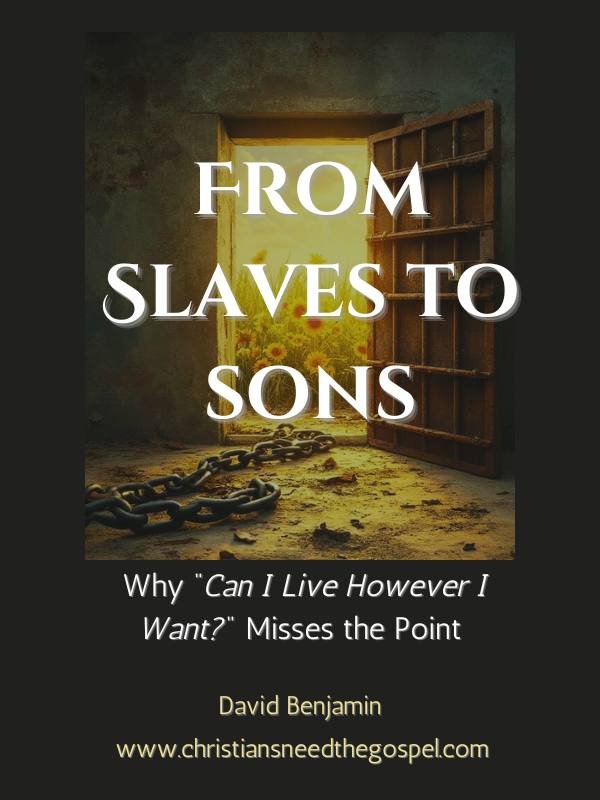
To “not love the world” is not to embrace poverty or asceticism. It is to reject the orphan mentality, to refuse to build a name for ourselves in a system that is passing away. It is to stand in the full assurance that we are sons—blessed, provided for, and secure in the Father’s love. Anything less is to return to slavery.
Let us be clear: you cannot be a friend of the world and a son of God. The world offers anxiety, manipulation, and counterfeit righteousness. The Father offers sonship, blessing, and rest. Choose your inheritance.
Books are the permanent organized form of this teaching. Browse print books or name-your-price ebooks.